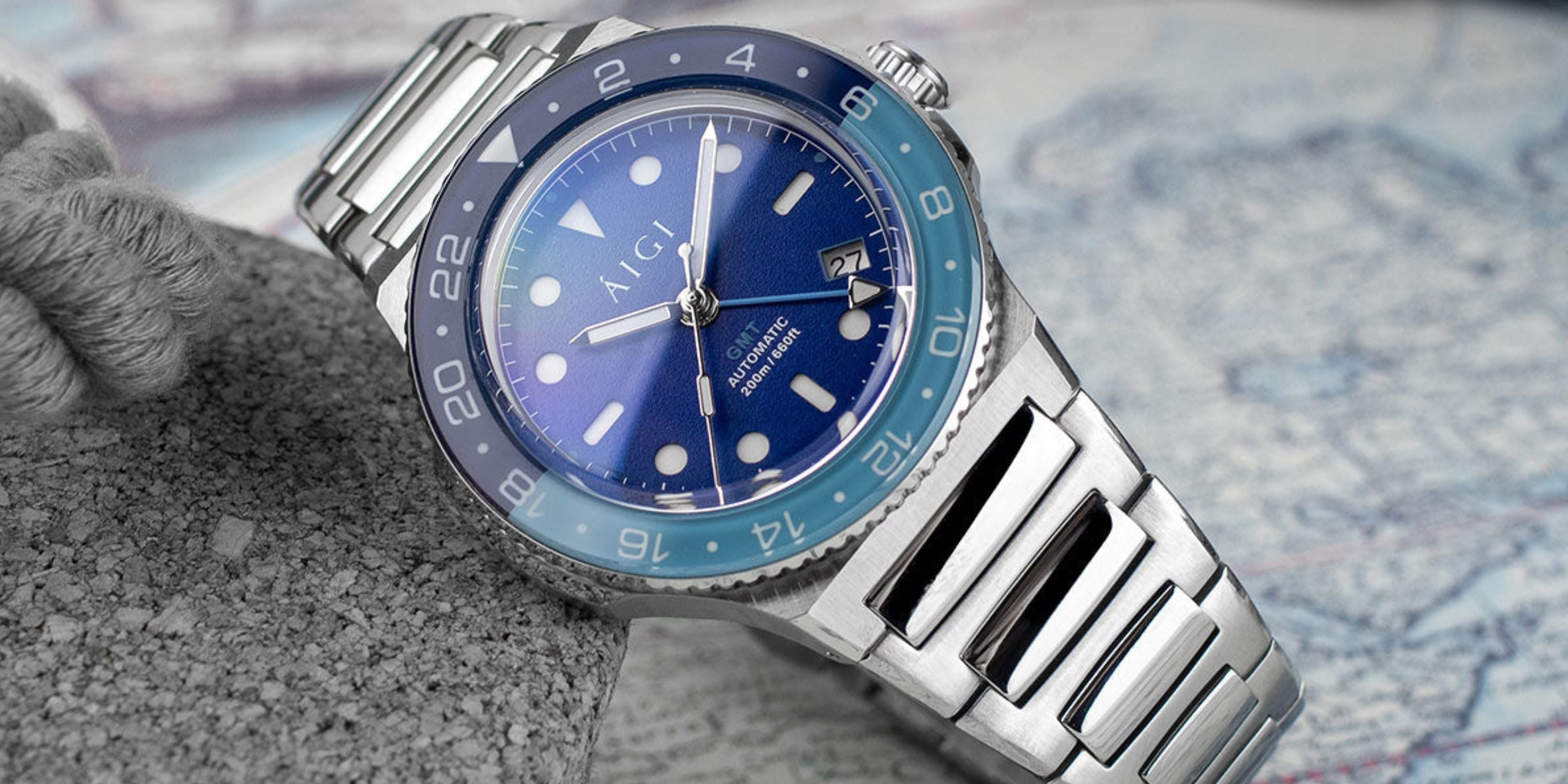
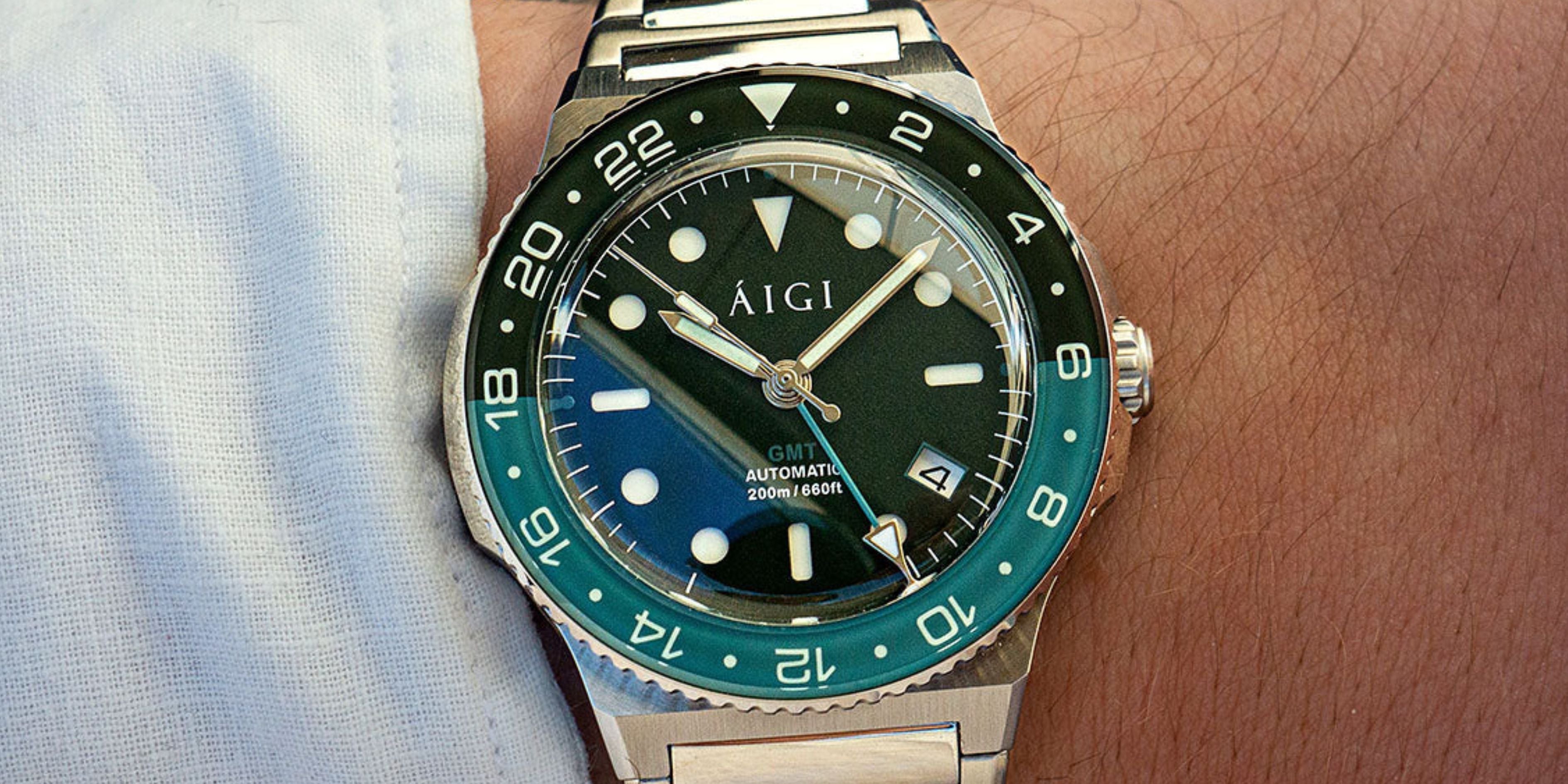
Automatic GMT watches are one of the most useful complications in modern watchmaking — especially for travelers, professionals working across time zones, and watch enthusiasts who appreciate mechanical functionality beyond basic timekeeping.
But not all GMT watches are created equal.
In this guide, we’ll explain how automatic GMT watches actually work, the crucial difference between true GMT and office GMT movements, and what to look for when choosing a GMT watch in 2026 — from established manufacturers to modern microbrand GMT watches.
What Is an Automatic GMT Watch?
An automatic GMT watch combines two key features:
-
Automatic movement – the watch is powered by the motion of your wrist, using a mechanical rotor to wind the mainspring.
-
GMT complication – an additional 24-hour hand that allows the watch to track a second time zone.
The GMT hand typically makes one full rotation every 24 hours and works in conjunction with a 24-hour scale on the dial or bezel.
Originally developed for pilots and long-distance travelers, GMT watches have become a staple among collectors thanks to their practicality and mechanical appeal.
True GMT vs Office GMT – The Difference That Actually Matters
This is the most important distinction — and one that separates casual GMT buyers from informed enthusiasts.
True GMT (Flyer GMT / Traveler GMT)
A true GMT (also known as a flyer GMT) is designed for people who actually travel between time zones.
Key characteristics:
-
The local hour hand jumps independently in one-hour increments.
-
The GMT hand remains fixed, tracking home time.
-
The movement does not stop when adjusting local time.
-
The date changes automatically when crossing midnight.
This is the most intuitive and traveler-friendly GMT configuration.
Examples of true GMT movements:
-
Miyota 9075
-
Rolex 3285
-
Omega 8906
If you fly frequently, this is the GMT movement you want.
Office GMT (Caller GMT)
An office GMT (sometimes called a caller GMT) is optimized for tracking a second time zone from a fixed location.
Key characteristics:
-
The GMT hand jumps independently.
-
The local hour hand does not jump.
-
Often requires stopping the movement when adjusting time.
-
Better suited for office work, remote teams, or business calls.
Common office GMT movements:
-
ETA 2893-2
-
Sellita SW330
-
Seiko NH34
Office GMT watches are still useful for tracking a second time zone — but they’re less convenient for frequent travelers.
How to Use a GMT Automatic Watch (Correctly)
The way you set a GMT watch depends entirely on the type of movement.
Setting a True GMT Watch
-
Unscrew or pull out the crown (depending on construction).
-
Set the GMT hand to your home time.
-
Adjust the local hour hand independently as you travel.
-
The date will follow local time automatically.
This allows seamless time zone changes without stopping the watch.
Setting an Office GMT Watch
-
Set local time normally.
-
Adjust the GMT hand to your secondary time zone.
-
Use the 24-hour scale to distinguish day/night.
This setup works well if you rarely change local time.
Key Features to Look for in Automatic GMT Watches
When evaluating the best automatic GMT watches, pay attention to the following:
1. Movement Quality
Reliable GMT movements are essential. Look for proven calibers with good service availability.
2. Case Size & Ergonomics
GMT watches often wear slightly larger due to the added complication. Case thickness and lug-to-lug length matter more than diameter alone.
3. 24-Hour Bezel
A rotating 24-hour bezel allows tracking a third time zone, especially useful for international travel.
4. Lume & Legibility
Clear differentiation between the hour hand and GMT hand is critical — especially at night.
5. Water Resistance
Even non-dive GMT watches should offer sufficient resistance for daily wear (100m is a good benchmark).
Why Microbrand GMT Watches Are Gaining Popularity
In recent years, microbrand GMT watches have become increasingly popular — and for good reason.
Microbrands often:
-
Use high-grade movements at lower prices
-
Offer limited production runs
-
Experiment with cleaner or more functional designs
-
Provide better value than mainstream luxury brands
The introduction of affordable true GMT movements like the Miyota 9075 has allowed microbrands to deliver traveler-grade GMT functionality at accessible price points — something that was almost impossible just a few years ago.
Types of Automatic GMT Watches
1. Sports GMT Watches
Rugged, water-resistant, often with rotating bezels — ideal for travel and outdoor use.
2. Dress-Oriented GMT Watches
Slimmer cases, refined dials, and understated bezels — suitable for business and formal settings.
3. Tool GMT Watches
Highly legible, lume-focused, purpose-built designs with minimal decoration.
Caring for Your GMT Automatic Watch
To keep your GMT watch running accurately:
-
Wear it regularly to keep the movement wound.
-
Avoid strong magnetic fields.
-
Rinse with fresh water after salt exposure.
-
Service the movement every 4–6 years depending on use.
A well-maintained GMT watch can easily last decades.
Are Automatic GMT Watches Worth It?
If you:
-
Travel frequently
-
Work across time zones
-
Appreciate mechanical functionality
-
Enjoy watches that offer real utility
Then yes — an automatic GMT watch is one of the most practical complications you can own.
Especially when choosing a true GMT movement, the convenience and usability become immediately obvious.
Final Thoughts: Choosing the Right GMT Watch
Automatic GMT watches represent a perfect balance of functionality and mechanical craftsmanship. Understanding the difference between true GMT and office GMT is crucial — and once you do, choosing the right watch becomes far easier.
Whether you’re exploring established brands or modern microbrand GMT watches, focus on movement architecture, legibility, and real-world usability rather than marketing buzzwords.
A good GMT watch doesn’t just tell time — it keeps you connected to multiple places at once.
FAQs
1. What is the difference between a GMT watch and a regular automatic watch?
A GMT watch displays at least two time zones, while a standard automatic watch only shows local time.
2. Is a true GMT better than an office GMT?
For frequent travelers, yes. A true GMT allows independent adjustment of local time without stopping the movement.
3. Are microbrand GMT watches reliable?
Many are. Microbrands often use proven movements and offer excellent value, especially with newer true GMT calibers.
4. Can a GMT watch track three time zones?
Yes — by using a rotating 24-hour bezel alongside the GMT hand.
5. Do GMT watches require more maintenance?
Not significantly. They follow standard mechanical service intervals.