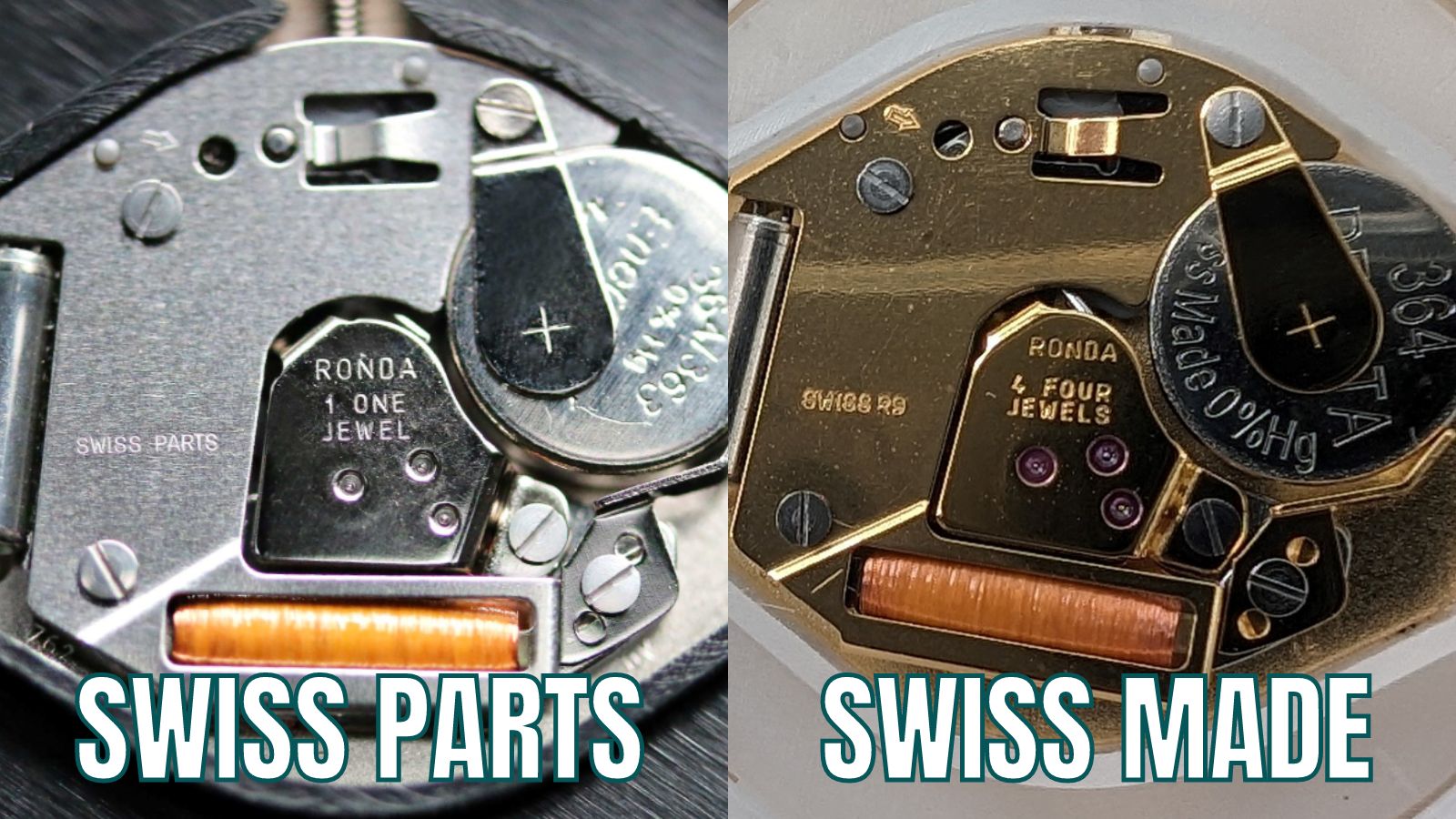
Quartz watches are often dismissed as the boring sibling of mechanical watchmaking, but Swiss quartz movements specifically have a more interesting story than they get credit for. They came out of one of the most disruptive periods in the history of the watch industry — and the manufacturers that survived built movements with a quality and longevity that's frequently underestimated.
This is a reference for what a Swiss quartz movement actually is, the history that produced it, the specific manufacturers you'll encounter, and how they compare to Japanese quartz alternatives. We use Swiss Ronda movements in several of our own watches, so the perspective here is grounded in actual production experience.
What is a Swiss quartz movement?
A Swiss quartz movement is a battery-powered watch mechanism produced in Switzerland (or with sufficient Swiss content to qualify under Swiss labeling rules — more on that distinction below). The core technology is the same as any quartz movement: a small battery sends current through a quartz crystal cut into a tuning-fork shape, which oscillates at exactly 32,768 times per second. The movement counts these oscillations, divides them down, and steps the seconds hand once per second.
What makes a movement "Swiss" rather than Japanese isn't the technology — it's the manufacturer and the country of assembly. Swiss quartz movements are made primarily by a small group of specialists: Ronda, ETA (part of the Swatch Group), and Soprod are the names you'll see most often in microbrand and mid-tier watchmaking today.
Note: "Swiss quartz" and "Swiss Made" aren't the same thing. The Swiss-made label is a regulated designation requiring at least 60% of value to be Swiss in origin, plus assembly and final inspection in Switzerland. A movement can use Swiss parts without qualifying for the Swiss-made label. We cover this distinction in detail in our Swiss parts vs Swiss made article — that's the right reference for the labeling and regulatory side. This post focuses on the movements themselves.
The Quartz Crisis — and why Swiss quartz exists at all
The history matters because it shaped what Swiss quartz movements look like today.
The first commercial quartz wristwatch was the Seiko Astron, released on December 25, 1969 — Japanese, not Swiss. Quartz was a Japanese-led innovation, and through the early 1970s Seiko, Citizen, and Casio drove the technology forward at speed. Swiss watchmaking, dominant for a century, was unprepared.
The result was the Quartz Crisis of the 1970s and early 1980s. Swiss watch employment dropped from roughly 90,000 to under 30,000 over a decade. Hundreds of brands disappeared. The industry consolidated brutally.
The Swiss response came in stages. The Beta-21, developed at the Centre Electronique Horloger (CEH) by a consortium of Swiss brands and launched at the 1970 Basel Fair, was defensive — the industry's attempt to catch up. ETA's Normline and Flatline quartz families and Ronda's early calibers followed. By the time the dust settled in the mid-1980s, Switzerland had repositioned: Swiss quartz wasn't going to lead on price (Japanese quartz was cheaper), so it leaned into the qualities Swiss watchmaking is built around — finishing, reliability, longer service intervals, and integration into watches at a higher price point than the bottom of the market.
This is the heritage you're buying into when you see a Swiss quartz movement today. Not first-mover innovation, but a refined response to a technology that nearly ended the industry.
The Swiss quartz manufacturers worth knowing
Ronda
Family-owned, based in Lausen near Basel, Ronda is one of the most widely used Swiss quartz manufacturers in microbrand watchmaking. Ronda's catalogue is split into "Normtech" (standard and long-life calibers) and "Powertech" (higher torque, NIHS 91-10 shock resistance, some long-life variants). The Ronda 762 — part of the Normtech 700 long-life family — is found in our own Aurora and Midnattsol 38mm models. It's a thin Swiss-made caliber (just 2.5 mm thick) with 4 jewels and a 10-year battery life on a Renata 364 cell, achieved by stepping the seconds drive every 20 seconds rather than every second.
ETA
Owned by the Swatch Group, ETA makes both quartz and mechanical movements. ETA quartz calibers (the F06, 955.412, and similar) are common in mid-tier Swiss watches. ETA has historically restricted supply of its movements to non-Swatch-Group brands, which is one of the reasons Ronda and Sellita (for mechanical) have grown — they fill the gap.
Soprod
Smaller than Ronda or ETA, Soprod produces both quartz and automatic movements with a focus on slimmer profiles and higher specifications. Less common in entry-level microbrands but appears in higher-tier Swiss-made watches.
Swiss quartz vs Japanese quartz — the practical differences
Both Swiss and Japanese quartz movements use the same fundamental technology. The differences are in execution, finishing, and positioning.
- Accuracy: Comparable. Both Swiss and Japanese quartz typically run within ±15 seconds per month. High-accuracy variants reach much further — ETA's Thermoline calibers and Citizen's Chronomaster sit at ±5 to ±10 seconds per year, and The Citizen Caliber 0100 reaches ±1 second per year — but those are exceptional movements, not the standard.
- Battery life: Roughly equivalent for standard movements (typically 2–5 years on common calibers). Both sides have long-life options that stretch this much further — Ronda's Normtech 700 family (including the 762) reaches 10 years through a slower step motor; Citizen's Eco-Drive achieves indefinite life through solar charging. Different mechanisms, similar end result for the wearer.
- Finishing and feel: Swiss quartz typically has more refined movement plate finishing visible through display casebacks. Most quartz watches don't have display casebacks, so this matters less in practice than it sounds.
- Service ecosystem: Both are well-supported. Japanese quartz has slightly broader parts availability globally; Swiss quartz has a more centralized service network through certified Swiss watchmakers.
- Cost: Japanese quartz movements (Miyota, Seiko, Citizen) are generally cheaper at the movement level. Swiss quartz commands a premium that reflects positioning more than absolute mechanical superiority.
For a closer look at the Japanese counterpart, see our Miyota watch movements explained article.
How a Swiss quartz watch works in daily use
A quartz watch needs almost nothing from its owner. Replace the battery when it dies (anywhere from 2–5 years on common calibers, up to 10 years on long-life Swiss movements like the Ronda 762), keep it dry, and that's most of what's required. The movement runs continuously while powered and is unaffected by being left off the wrist for long periods, unlike a mechanical watch which needs to be wound or worn.
Two practical notes from our own production experience:
- If a quartz watch has been sitting unused for a long time, the battery may have leaked or oxidized. We routinely see this in vintage quartz watches that come in for service. If you're storing a quartz watch for over a year, pull the battery first.
- Quartz movements are sensitive to magnetism just like mechanical movements, but they recover differently. A magnetized mechanical watch runs fast or stops; a magnetized quartz watch usually keeps time correctly but the seconds-hand stepping can become erratic. If you notice a quartz watch's seconds hand jumping or stuttering unevenly, demagnetization is the first thing to try.
Service intervals and longevity
Swiss quartz movements typically run 10–15 years before needing more than a battery change. At that point, lubricants in the gear train benefit from a service. A full service on a Swiss quartz movement runs €80–€150 in Europe, depending on the watchmaker.
The case and gaskets need more attention than the movement itself. Pressure testing every few years (especially before swimming or diving) is the most useful preventive maintenance. Most "broken" quartz watches we see aren't broken movements — they're cases that took on water through a worn gasket.
Where Swiss quartz fits today
Swiss quartz makes most sense in three contexts:
- Slim dress and casual watches where a thin profile matters more than mechanical character — Ronda 762 calibers fit in cases under 7 mm thick
- Reliable everyday watches where the owner doesn't want to think about winding or accuracy drift
- Watches at price points where a Swiss-made label adds value to the customer but Swiss mechanical movements (Sellita SW200-1 territory) would push the price too high
Our women's collection uses the Swiss-made Ronda 762 across several models for exactly these reasons. The thin profile lets us keep cases under 7 mm thick, the reliability matches the use case (occasional formal wear, light daily use), and the Swiss-made designation matters to the customer for that category.
For a buyer's-side perspective on which quartz watches are worth it, see our top quartz watches buying guide.
Summary
A Swiss quartz movement is a battery-powered watch movement made (or substantially made) in Switzerland by manufacturers like Ronda, ETA, and Soprod. The technology — quartz crystal oscillating at 32,768 Hz — is identical to Japanese quartz, but Swiss quartz commands a premium based on finishing, positioning, and the cachet of Swiss watchmaking heritage.
That heritage is more nuanced than it's often presented. Swiss quartz exists because the Quartz Crisis of the 1970s forced Swiss watchmaking to respond to a Japanese-led innovation, not because Switzerland led the technology. The manufacturers that survived built quartz movements with the qualities Swiss watchmaking is known for — refined finishing, longer service intervals, and reliability — at price points where Japanese alternatives compete on cost rather than craft.
For most everyday quartz needs, Japanese alternatives are perfectly capable and cheaper. Swiss quartz earns its place when the watch's positioning, profile, or use case justifies the premium.
Frequently Asked Questions
What is a Swiss quartz movement?
A Swiss quartz movement is a battery-powered watch mechanism produced in Switzerland by manufacturers like Ronda, ETA, or Soprod. It uses a quartz crystal oscillating at 32,768 times per second to keep time, and is "Swiss" by virtue of where it's made rather than how the technology works.
Are Swiss quartz movements better than Japanese quartz?
Not in terms of timekeeping. Both Swiss and Japanese quartz movements typically run within ±15 seconds per month. Swiss quartz tends to have more refined movement finishing and a longer service interval, but Japanese quartz is generally cheaper and has broader global parts availability. The choice depends more on the watch's positioning than absolute mechanical superiority.
Is a Swiss quartz movement automatic?
No. Quartz movements are battery-powered, not automatic. "Automatic" specifically refers to mechanical movements that wind themselves through wrist motion. A quartz movement runs on battery power and needs no winding — the trade-off being that the battery needs replacement periodically (commonly every 2–5 years, up to 10 years on long-life Swiss calibers like the Ronda 762).
What's the difference between Swiss quartz and Swiss Made?
"Swiss quartz" describes the movement itself — battery-powered, made in Switzerland. "Swiss Made" is a regulated label requiring at least 60% of the watch's value to be Swiss in origin, plus assembly and final inspection in Switzerland. A watch can use a Swiss quartz movement without qualifying for the Swiss Made label, depending on the rest of its components.
How long does a Swiss quartz movement last?
With regular battery changes (every 2–10 years depending on caliber) and periodic case servicing, a Swiss quartz movement can run reliably for 20–30 years or more. The most common cause of failure isn't the movement — it's water damage from a worn gasket or a leaking battery in storage.
What watches use the Ronda 762 movement?
The Ronda 762 is a Swiss-made quartz caliber found in thin dress and casual watches, including our own Aurora and Midnattsol 38mm models. It's a 4-jewel movement from Ronda's Normtech 700 long-life family, with a 10-year battery life on a Renata 364 cell, and is appreciated for keeping cases under 7 mm thick.