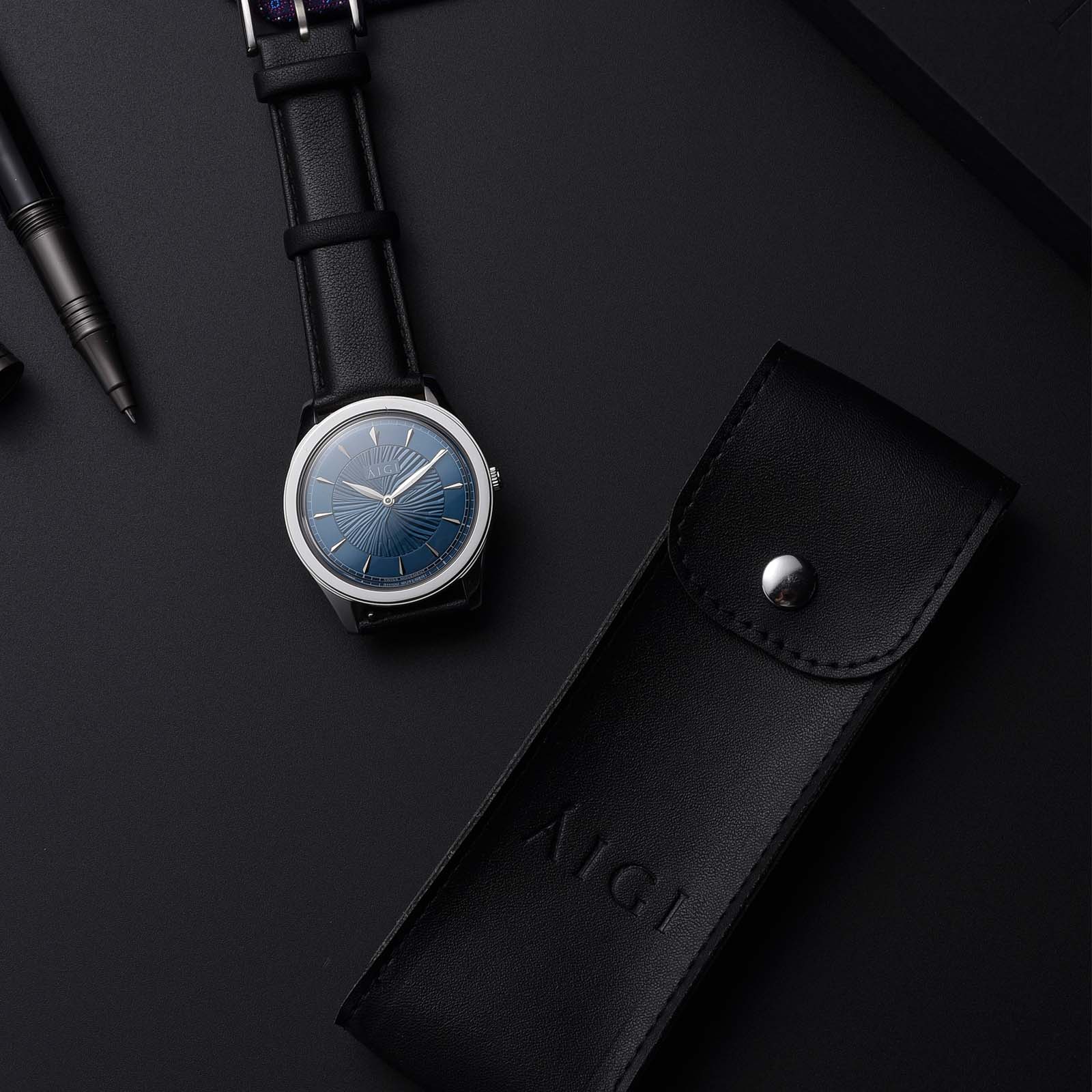
The first time we cased a quartz movement for one of our thinner watches, what struck us was how little there is to it. A mechanical movement is a small machine — dozens of tiny parts, a mainspring, a balance wheel swinging back and forth. A quartz movement looks almost empty by comparison: a circuit board, a coil, a battery, and a sliver of crystal you could miss if you weren't looking for it. And yet that quiet little board keeps far better time than the elaborate machine next to it. Understanding how a quartz watch works is mostly a matter of following the signal from that crystal to the hands on the dial.
What is a quartz watch movement?
A quartz watch is a battery-powered watch that keeps time using the steady vibration of a quartz crystal. Where an automatic watch draws its energy from the motion of your wrist, a quartz watch draws its energy from a small cell, and instead of a balance wheel regulating the timekeeping, it uses the crystal. That single design choice — electronic regulation instead of mechanical — is why a typical quartz watch is more accurate, thinner, and lower-maintenance than its mechanical counterpart.
The technology is not new. On 25 December 1969, Seiko unveiled the Astron, the world's first quartz wristwatch, accurate to around ±5 seconds per month at a time when a fine mechanical watch might drift several minutes in the same period. That launch set off the quartz revolution, and the basic architecture inside the Astron is still the architecture inside almost every quartz watch made today.
How does a quartz watch work, step by step?
It helps to follow the energy through the movement in order. There are really only four stages.
1. The battery supplies power. A small silver-oxide cell sends a steady low voltage into the circuit. That current is what gets the whole system going.
2. The quartz crystal vibrates. The current passes through a tiny quartz crystal, usually cut into the shape of a tuning fork. Quartz is piezoelectric, which means it flexes when voltage is applied and, conversely, generates a small voltage when it flexes. Drive it with the battery and it oscillates at a remarkably stable rate — 32,768 times per second in virtually every watch. That number isn't arbitrary: it is 2 to the 15th power, high enough to sit just above human hearing and stable enough to act as a near-perfect metronome.
3. The integrated circuit counts and divides. The circuit takes that 32,768 Hz signal and halves it, again and again — fifteen times — until 32,768 vibrations become exactly one pulse per second. This is the clever part: counting electrons is far more precise than counting the swings of a balance wheel.
4. The stepper motor moves the hands. Each one-second pulse is sent to a stepper motor — a tiny electromagnetic coil that converts the electrical pulse into a single mechanical step. That step turns a train of gears, and the gears move the hands. This is why a standard quartz second hand ticks: it advances once per second, one pulse at a time, rather than gliding.
Why are quartz watches so accurate?
The short answer is that a quartz crystal is a more consistent timekeeper than a mechanical balance. A balance wheel's rate is affected by position, temperature, the state of the mainspring, and wear. A quartz crystal's frequency barely moves by comparison. A standard 32,768 Hz crystal is rated for an accuracy of roughly six parts per million — in practice, a typical quartz watch gains or loses around 15 seconds a month, where a good mechanical movement is doing well to stay within 15 seconds a day.
There is a tier above standard quartz, too. High-accuracy quartz movements use temperature compensation to hold the rate within a few seconds per year. Most everyday quartz watches don't go that far — they don't need to — but it shows how much headroom the technology has.
What about the battery — and the ticking?
Two things people ask us most often: how long the battery lasts, and whether the ticking second hand means a watch is cheap. Neither has a simple one-line answer.
Battery life varies enormously by movement. Many quartz watches run one to three years on a cell. But this is exactly where a blanket figure misleads people. The Swiss Ronda 762 we use in some of our slim dress watches is rated for around ten years, because its motor steps the hand less frequently to conserve power. So quartz batteries lasting a couple of years is true on average and wrong for specific calibers — always check the movement, not the category. We go deeper into this in our guide to Swiss Ronda movements.
The ticking is a design decision, not a quality marker. A standard quartz motor pulses once per second, so the hand jumps once per second. Some quartz movements step several times per second for a near-smooth sweep, and hybrid movements behave differently again. Which brings us to the interesting middle ground.
Quartz, mecha-quartz, and where ours sit
Not every quartz watch is a plain three-hander. Our Arctic Chrono II uses a mecha-quartz movement — quartz-driven timekeeping paired with a cam-actuated mechanical chronograph. You get the accuracy and low maintenance of quartz for telling the time, plus tactile pushers and snap-back chronograph hands that feel mechanical to use. It is not a mechanical chronograph and we never pretend it is; it is a deliberate combination that suits a chronograph you actually want to use daily. If that hybrid interests you, our piece on what a meca-quartz movement is explains it in full, and you can see the watch itself on the Arctic Chrono II page.
We reach for quartz when the brief calls for it: a watch that needs to be slim, a chronograph that should be robust and grab-and-go, or a dress watch where an automatic rotor would simply add unnecessary thickness. In our experience the practical gap between a good quartz movement and a good automatic is smaller than the marketing around mechanical watches suggests — they are different tools, not better and worse ones. For the longer history and the Swiss side of the story, see our explainer on the Swiss quartz movement.
Summary
A quartz watch works by sending battery current through a quartz crystal that vibrates 32,768 times a second; an integrated circuit divides that into one pulse per second; and a stepper motor turns those pulses into the movement of the hands. The result is a movement that is thin, accurate to within seconds a month, and easy to live with. The details that matter — battery life, the tick versus the sweep, plain quartz versus mecha-quartz — come down to the specific movement, not the word quartz on its own.
Frequently Asked Questions
How does a quartz watch work in simple terms?
A battery sends current through a quartz crystal, which vibrates 32,768 times per second. A circuit counts those vibrations and turns them into exactly one pulse per second, and a stepper motor converts each pulse into a small movement of the hands. That is the entire chain, from power source to the time on the dial.
Why does a quartz crystal vibrate at 32,768 Hz?
32,768 is 2 to the 15th power, so a circuit can halve the frequency exactly fifteen times to arrive at one pulse per second. The frequency is also high enough to sit just above human hearing and low enough to keep power consumption and cost down, which is why nearly every quartz watch uses it.
Are quartz watches more accurate than automatic watches?
Yes, as a rule. A typical quartz watch gains or loses around 15 seconds per month, while a good automatic watch is doing well to stay within about 15 seconds per day. Quartz regulates time electronically with a crystal, which is far more stable than the mechanical balance wheel in an automatic movement.
How long does a quartz watch battery last?
It depends on the movement. Many quartz watches run one to three years on a cell, but long-life Swiss calibers such as the Ronda 762 are rated for around ten years because the motor steps the hand less often to save power. Always check the specific movement rather than assuming a single figure for all quartz watches.
Why does a quartz second hand tick instead of sweep?
A standard quartz movement sends one pulse per second to the stepper motor, so the second hand advances once per second — the familiar tick. Some quartz movements pulse several times per second for a near-smooth sweep, and the tick says nothing about quality; it is simply how that particular motor is driven.