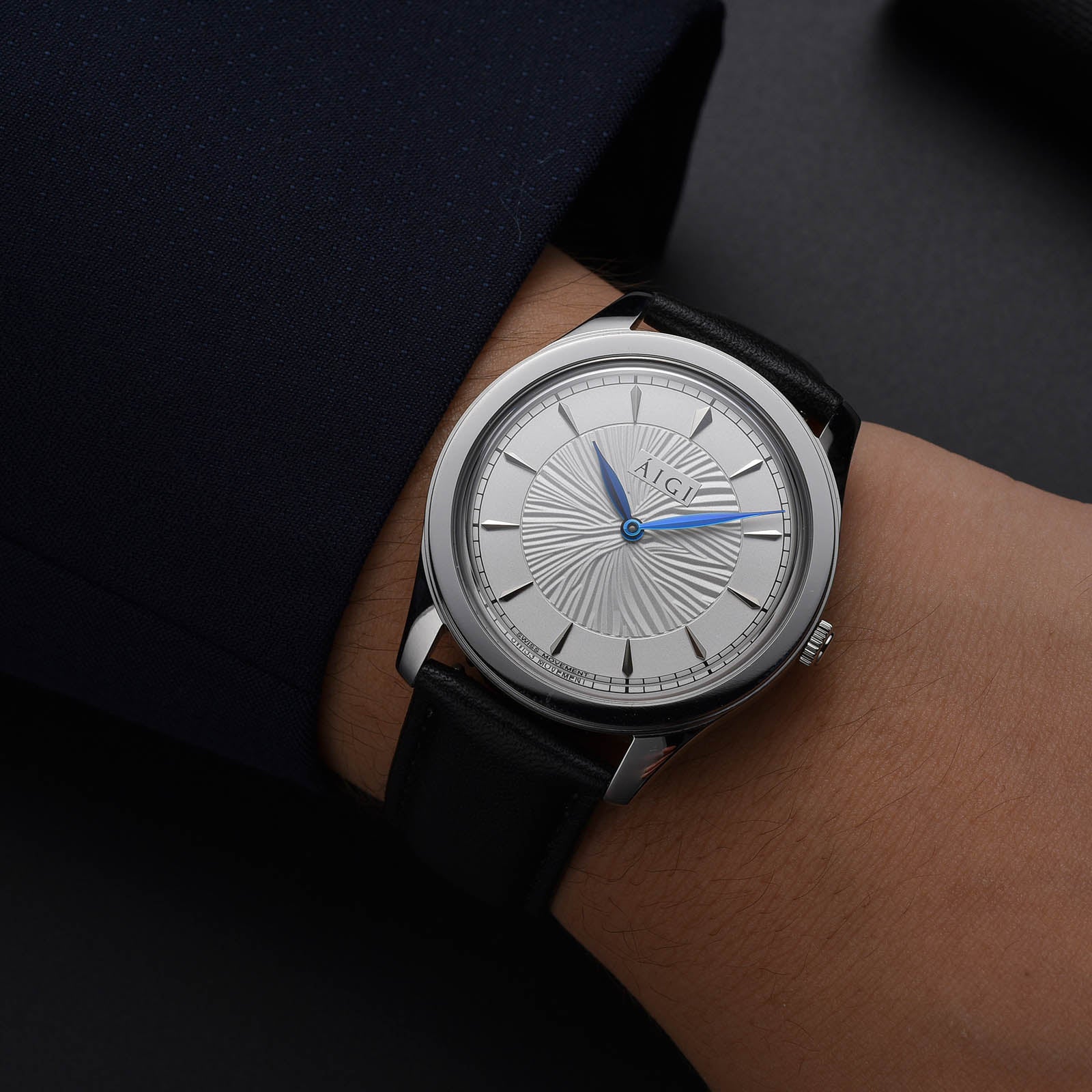
Every week we get questions from customers that come down to vocabulary: what does "caller GMT" actually mean, is meca-quartz the same as quartz, and does a 10 ATM watch survive a swim? Watch terminology can feel like a private language. This glossary is the reference we wish we'd had when we started designing watches — every term explained in plain language, with honest notes on what matters in practice and what's mostly marketing.
Terms are grouped by theme so you can read it as a short course, or jump to the word you came for.
What are the main types of watch movement?
Movement
The movement is the engine of the watch — the mechanism that keeps time and drives the hands. It is the single biggest factor in how a watch performs and what it costs. Almost everything else in watch terminology hangs off this word.
Mechanical movement
A movement powered by a coiled spring (the mainspring) rather than a battery, regulated by a balance wheel. Hand-wound mechanical watches are wound via the crown; automatic ones wind themselves. Mechanical watches trade some accuracy for craft, longevity and the fact that they run without electronics.
Automatic movement
A mechanical movement with a weighted rotor that spins as you move your wrist, winding the mainspring automatically. Wear it daily and it never needs winding. Our Gruvebus uses the Swiss Sellita SW200-1 automatic; our Satellite Ground Station II uses the Japanese Miyota 9039. In our experience, the practical difference between a well-adjusted Japanese and Swiss automatic is smaller than spec sheets suggest.
Quartz movement
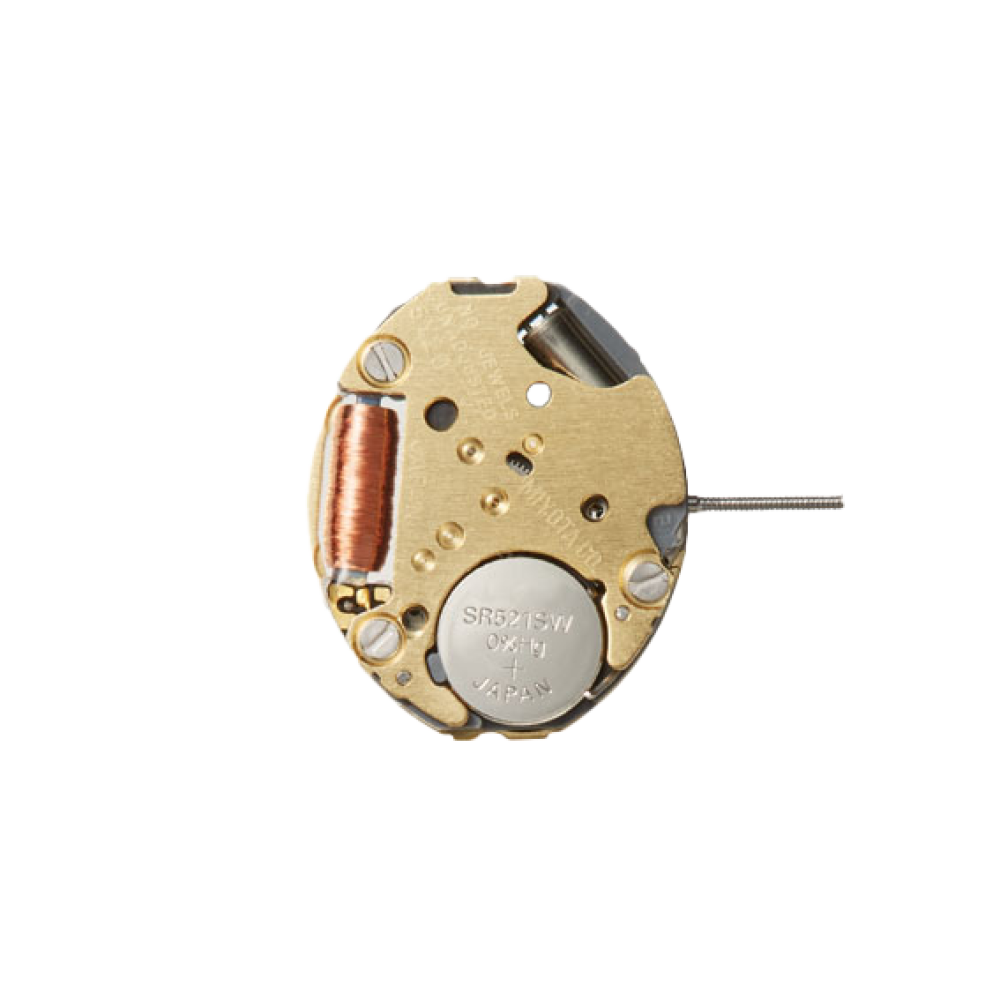
A battery-powered movement that keeps time with a vibrating quartz crystal. Quartz is far more accurate than mechanical and needs almost no maintenance beyond battery changes. If you want the full picture, we've written a dedicated guide to how a quartz watch works.
Meca-quartz
A hybrid chronograph movement: quartz-driven timekeeping combined with a mechanical chronograph module. You get quartz accuracy plus the tactile pushers and snap-back chronograph hands of a mechanical chronograph, at a fraction of the cost. Our Arctic Chrono II uses the Seiko VK64, which is quartz-driven with a cam-actuated chronograph reset. More in our meca-quartz guide.
Caliber (calibre)
The model designation of a specific movement — Sellita SW200-1, Seiko NH34, Miyota 9039 and so on. When someone asks "what caliber is in it?", they're asking exactly which movement the watch uses.
What do the movement spec terms mean?
Power reserve
How long a fully wound mechanical watch keeps running once you take it off. Most automatics in our range sit around 38–42 hours: the Sellita SW200-1 in the Gruvebus runs about 38 hours, the Miyota 9039 about 42. Take the watch off on Friday evening and a 38-hour reserve means it has stopped by Sunday — that's the practical meaning.
Beat rate (vph / bph)
How many vibrations per hour the balance wheel makes. Common rates are 21,600 vph (like the Seiko NH34) and 28,800 vph (like the Sellita SW200-1 and Miyota 9039). A higher beat rate gives a smoother-sweeping seconds hand. It's an aesthetic and engineering trait — not a quality verdict on its own.
Jewels
Small synthetic rubies used as low-friction bearings at points of wear inside the movement. A typical automatic has 24–26 jewels. More jewels is not automatically better — the number simply reflects the movement's construction.
Hacking seconds
The seconds hand stops when you pull the crown out, so you can set the watch to the exact second. Most modern automatics, including everything we currently use, hack.
Hand-winding
The ability to wind an automatic movement manually via the crown — useful for starting a stopped watch without shaking it. Not all automatics have it; all of ours do.
What is a complication?
Any function beyond hours, minutes and seconds: a date window, a chronograph, a second time zone. The word sounds negative but it's neutral watchmaker vocabulary — a date is technically a complication.
Chronograph
A watch with a built-in stopwatch, operated by pushers and read on sub-dials. Often confused with chronometer, which is something else entirely (below). Our full chronograph guide covers how to use one.
Chronometer
A precision certification, not a function. A chronometer is a watch whose movement has passed independent accuracy testing to a defined standard. A chronograph can be a chronometer, but the words are not interchangeable.
GMT watch
A watch that displays a second time zone, usually via an extra 24-hour hand. The name comes from Greenwich Mean Time, the reference point for the world's time zones. There are two fundamentally different GMT mechanisms, and knowing the difference matters more than any other single term on this list if you're shopping for one.
Caller GMT (office GMT)
The 24-hour hand is independently adjustable, while local time stays fixed. Ideal for tracking a second time zone from home — knowing when to call a colleague abroad. Our Arctic GMT uses the Seiko NH34, a caller GMT. For most people who don't fly weekly, this is the more practical type, not a compromise.
Traveller GMT (true GMT, flyer GMT)
The local hour hand is independently adjustable in one-hour jumps, while the watch keeps running. When you land in a new time zone, you jump the hour hand without disturbing timekeeping. Designed for people who actually cross time zones. We compare both types in our automatic GMT guide.
What do the case and exterior terms mean?
Case
The housing that holds the movement and dial. Watch size is quoted as case diameter in millimetres — 38–42 mm covers most men's watches today. If you're unsure what fits your wrist, our 38 mm size guide goes deeper.
Caseback
The back of the case. Screw-down casebacks improve water resistance; exhibition casebacks have a glass window so you can see the movement.
Bezel
The ring around the crystal. It can be fixed and purely aesthetic, or functional — a dive bezel rotates to track elapsed time, a GMT bezel carries a 24-hour scale.
Crown
The knob on the case side used to set the time and date, and to wind mechanical watches.
Screw-down crown
A crown that threads onto the case to seal it, significantly improving water resistance. Found on serious dive watches. One practical habit: always check it's screwed back down before water.
Crystal
The glass over the dial. Three main types: acrylic (cheap, scratches easily, but polishable), mineral (harder, mid-range), and sapphire (very scratch-resistant, used on higher-end watches). We use sapphire with an internal anti-reflective coating on all our watches — here's why we chose sapphire.
Lugs
The arms extending from the case that hold the strap via spring bars. Lug width, measured in millimetres, decides which straps fit. Drilled lugs have small through-holes that make strap changes easier.
Integrated bracelet
A bracelet whose first link is shaped to flow seamlessly into the case — the case is designed around the bracelet, so standard straps won't fit. Our Arctic GMT and Arctic Chrono II use genuine integrated bracelets. Our integrated strap guide covers the look, the trade-offs and the alternatives.
Lume
The luminous material on hands and indices that glows in the dark after charging in light. We use Swiss Super-LumiNova® — it's a photoluminescent pigment, not radioactive, and it recharges indefinitely.
What does water resistance actually mean?
ATM / water resistance
Water resistance is rated in atmospheres (ATM) or metres. The ratings describe lab test pressure, not real diving depth, so read them practically: 3 ATM handles rain and splashes; 10 ATM handles swimming and everyday water exposure.; 20 ATM is dive-watch territory. Gaskets age, so have them checked if the watch sees regular water. Full details in our water resistance guide.
Gasket
The rubber or polymer seals at the crown, caseback and crystal that keep water out. The quiet heroes of water resistance — and the part that ages first.
What do the buying-scene terms mean?
Microbrand
A small, independent watch brand that designs in-house and typically sells directly to customers online, rather than through dealer networks. That's us — and the model is why microbrand watches usually offer more specification per dollar than equivalent watches from large brands. We've written an honest look at what microbrand watches are.
Swiss movement vs Swiss Made
A watch can use a Swiss movement (like our Sellita SW200-1) without the whole watch qualifying for the legal "Swiss Made" label, which has strict requirements covering assembly and value share. The distinction trips up a lot of buyers — our Swiss Parts vs Swiss Made guide untangles it.
Deployant clasp
A folding clasp that opens into a hinged cradle, so the bracelet or strap stays in a loop. More secure than a pin buckle and gentler on leather straps.
Frequently Asked Questions
What is the difference between a chronograph and a chronometer?
A chronograph is a watch with a stopwatch function, operated by pushers. A chronometer is a watch whose movement has passed independent precision certification. The terms describe completely different things: one is a feature, the other is a tested accuracy standard.
What does GMT mean in watch terminology?
GMT stands for Greenwich Mean Time, the historical reference for the world's time zones. A GMT watch shows a second time zone with an extra 24-hour hand. There are two types: caller GMTs (independently adjustable 24-hour hand, best for tracking a zone from home) and traveller GMTs (independently jumping local hour hand, best for frequent flyers).
How many watch jewels is a good number?
A typical three-hand automatic uses 24–26 jewels, and that is exactly as many as it needs. The jewels are friction bearings, and the count reflects the movement's design rather than its quality — more jewels in the same architecture would add nothing.
Is meca-quartz a real mechanical movement?
No. A meca-quartz movement keeps time with a battery-powered quartz module, while the chronograph functions use mechanical components — giving tactile pushers and an instant snap-back reset. It combines quartz accuracy with mechanical chronograph feel, but the timekeeping itself is quartz.
What watch terminology matters most when buying a first watch?
Four terms cover most of the decision: movement type (automatic, quartz or meca-quartz — drives price and maintenance), case diameter in millimetres (decides fit), crystal type (sapphire resists scratches best), and water resistance in ATM (3 ATM for daily life, 10 ATM if the watch will swim). Everything else is refinement.