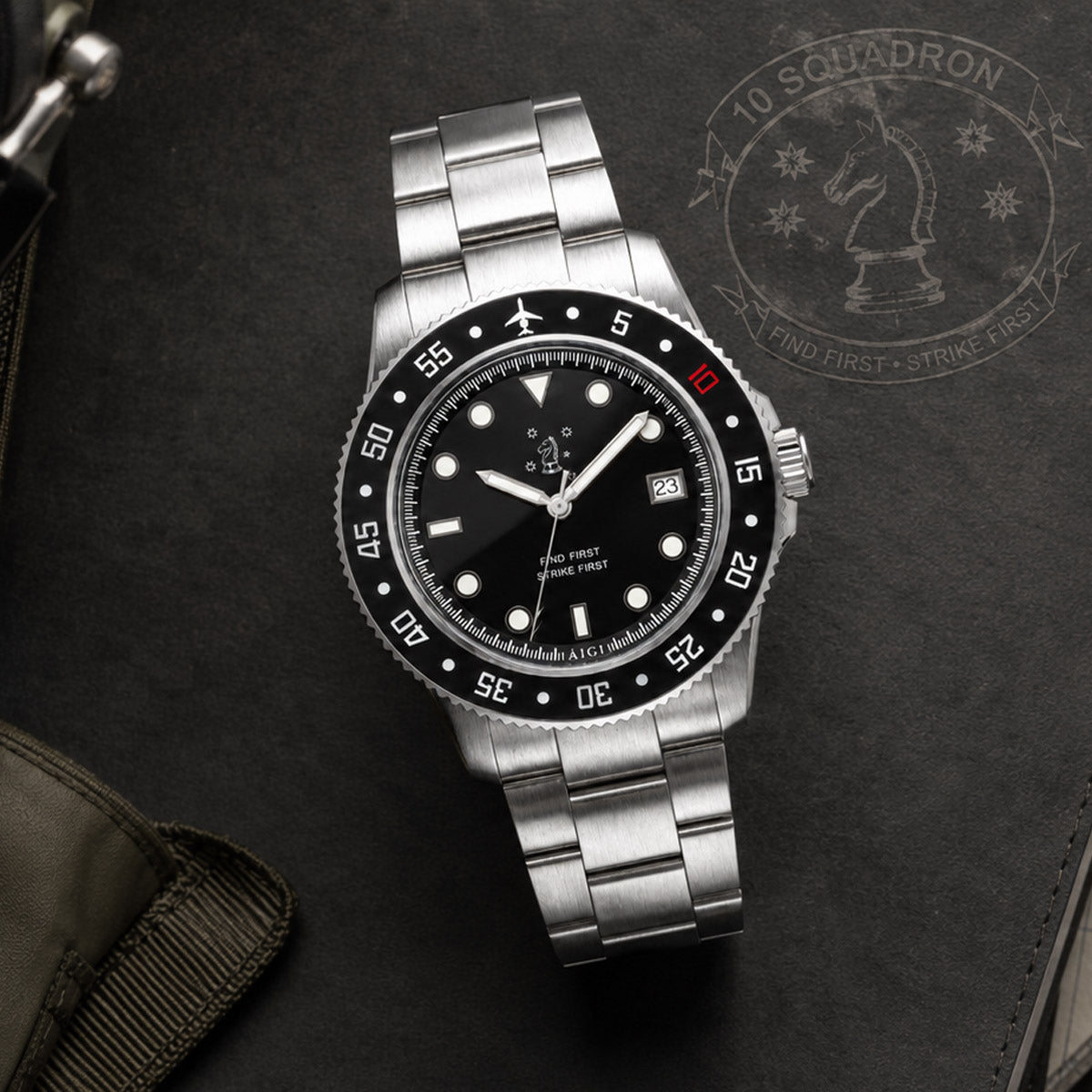
One of our squadron projects began not with a movement or a dial colour, but with a crest, a callsign, and a sentence: "We want something the whole squadron will still wear in ten years." That is the honest core of what a military watch is — not a marketing category, but a tool built to be legible, durable, and meaningful to the people who wear it. This guide explains what genuinely makes a watch military-grade, and how units and squadrons commission their own — including a few we have built.
One thing worth saying up front: a military watch does not have to live a military life. Many people want this kind of watch precisely for everyday wear — the legibility, the toughness, and the honest, no-nonsense character make for an excellent daily watch. The military-grade specification simply means it will also handle work without complaint. For commemorative unit pieces especially, most owners wear them with pride off duty, every day, for years — the field-ready build is reassurance, not a daily requirement.
What makes a watch "military"?
Strip away the styling and a military watch is defined by function, not looks. Historically, military-issue watches had to be readable in any light, resist water and shock, and avoid reflective surfaces that could give away a position. Those priorities still define a good field or service watch today:
Legibility first — high-contrast dials, clean numerals, and strong lume so the time reads instantly. Lume that lasts the night — quality luminous material on both hands and markers; our current models use Swiss Super-LumiNova. Water and shock resistance — a service watch should shrug off rain, washdowns, and knocks, ideally with a screw-down crown. Anti-reflective sapphire — a hardened, anti-reflective crystal that stays readable and resists scratches.
In our experience, the watches that survive years of service are the simple, legible ones — not the most feature-packed. A clean three-hander with strong lume outlasts a busy dial almost every time.
What watch does the military actually use?
There is no single answer — different forces and eras have issued very different watches. The common thread is always the same priority list: read-at-a-glance legibility, robustness, and dependable, easy-to-service movements over decoration. That is why a well-built field watch, dive watch, or pilot-style watch can all be "military" in the practical sense. The category is about fitness for purpose, not a badge — and it is why we build around reliable Japanese and Swiss movements rather than exotic ones.
Types of military-style watches
Field watches prioritise legibility and toughness in a compact case. Dive watches add serious water resistance and a timing bezel. Pilot and GMT watches add a second time zone. Our Arctic GMT is an example of the last: it uses a Japanese Seiko NH34 caller GMT, where the independently adjustable 24-hour hand tracks a second zone (for example, home time) while local time runs on the main hands. It is rated to 200 metres with a screw-down crown.
How units and squadrons commission their own watches
This is work we genuinely do, and it is where a small, hands-on brand has an advantage. A unit, squadron, ship, company, or association can commission a limited run built around its identity. In practice, the elements we personalise most often are the dial (a crest or emblem, unit colours, a motto), the bezel insert (a silhouette, squadron number or marking), the hands (we have shaped a second hand like a missile for a fighter squadron), the caseback (an engraved emblem or relief, plus individual numbering and personalized text ), the crown, and even the rotor visible through the caseback — which we have engraved with a callsign or made custom.
A few examples of what that looks like in finished form:
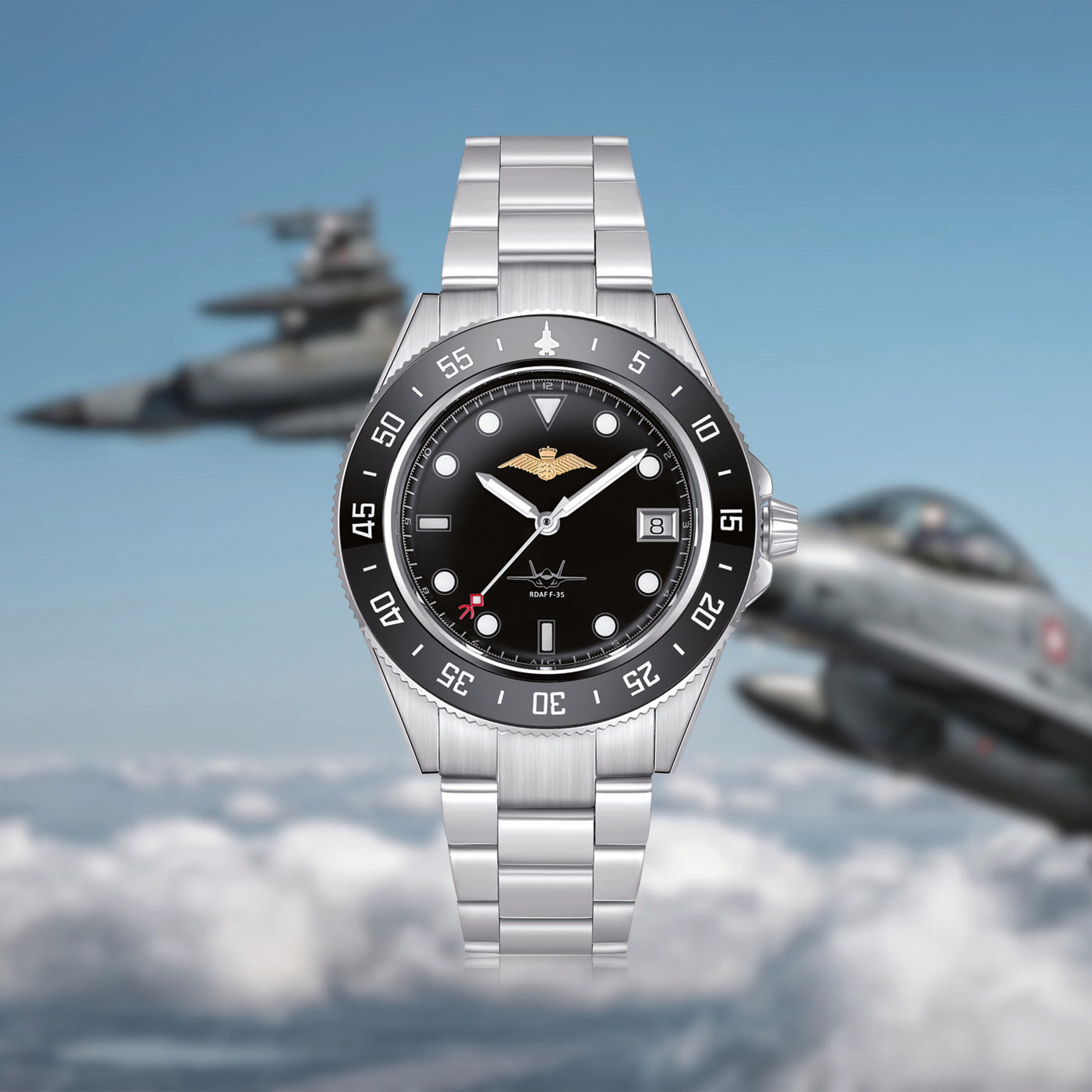
- For the Royal Danish Air Force, we built an F-35 piece with the air force wing on the dial, F-35 detailing on the bezel and dial, a ceramic bezel insert, and a crown shaped like an afterburner — on a Swiss Sellita SW200 movement.
- For the US Air Force's 52nd Fighter Squadron, the "Banzai" watch carried an F-35 Lightning II silhouette on a black sandwich dial, the squadron's "BANZAI!" motto engraved, a red "52" on the ceramic bezel, a missile-shaped second hand, and a custom rotor with the caseback engraved with the callsign — read the full F-35 squadron project.
- For the Royal Norwegian Navy, we marked the 150th anniversary of the MTB Skjold class with a limited series of 199 pieces..
- And our KSAT satellite-ground-station project shows the same approach applied to a technology organisation, including a crown made from steel taken from their station in Antarctica.
What every one of these shares is a principle we hold to: the watch has to stand on its own as a credible timepiece first, with the unit's identity integrated elegantly — not slapped on like merch. The components and movements meet the same standard as our regular collections.
The practical side of a commission is collaborative. Quantities, timeline, and what can be personalised all depend on the project — custom runs are typically produced as limited editions for a group rather than off a fixed template — so rather than quote numbers that would not apply to your case, we would rather work through it with you. Start on our military watches page or our custom watches page.
A note on honesty
We're a Norwegian brand: we design and develop our watches in Norway, and build them around Japanese and Swiss movements with other premium components sourced from around the world. We don't claim a mil-spec certification we don't hold, and we won't overstate what a watch can take. What we offer is an honest, legible, durable watch — and the ability to make it genuinely yours.
Summary
A military watch is defined by function: legibility, strong lume, water and shock resistance, and reliability over decoration. The "best" one is whatever is fit for how it will actually be used — and for many people, that means a tough, legible watch worn mostly off duty, with the field-ready build there as reassurance rather than a daily demand. And when you commission for a unit, the watch becomes something more — a shared marker of a shared experience, often worn with pride long after the posting ends, which is exactly the kind of project we like to build.
Frequently Asked Questions
What makes a watch military-grade?
Function over styling: high-contrast legibility, strong lume on hands and markers, water and shock resistance, an anti-reflective hardened crystal, and a reliable, serviceable movement. Historically, issued watches had to be readable in any light and tough enough for field use — those priorities still define a good military-style watch today.
What watch does the military use?
There is no single issued watch — it varies by force and era. The constant is the priority list: read-at-a-glance legibility, robustness, and dependable, easy-to-service movements rather than exotic or decorative ones. A well-built field, dive, or pilot watch can all be military in the practical sense.
Can a unit or squadron order custom watches?
Yes — this is something we do, from air force squadrons to navy anniversaries. A unit can commission a limited run with a custom dial, a squadron number on the bezel, an engraved caseback, individual numbering, custom hands, or a callsign-engraved rotor. Because every project differs in design, quantity, and timeline, we work through the details together. Start on our custom watches page.
Can you wear a military watch every day, off duty?
Absolutely — and most people do. A good military-style watch is legible, tough, and understated, which makes it an easy everyday watch. The military-grade build (water and shock resistance, strong lume, anti-reflective sapphire) means it also handles work and the outdoors, but it does not need a posting to earn its place. Commemorative unit watches in particular are usually worn with pride in civilian life and kept for years.
Is a GMT watch useful for military or service use?
It can be, for anyone coordinating across time zones. A GMT watch shows a second time zone on a 24-hour hand. Our Arctic GMT uses a caller GMT, where the 24-hour hand is set independently to track home or another zone while local time runs normally — practical for keeping two times in view at a glance.